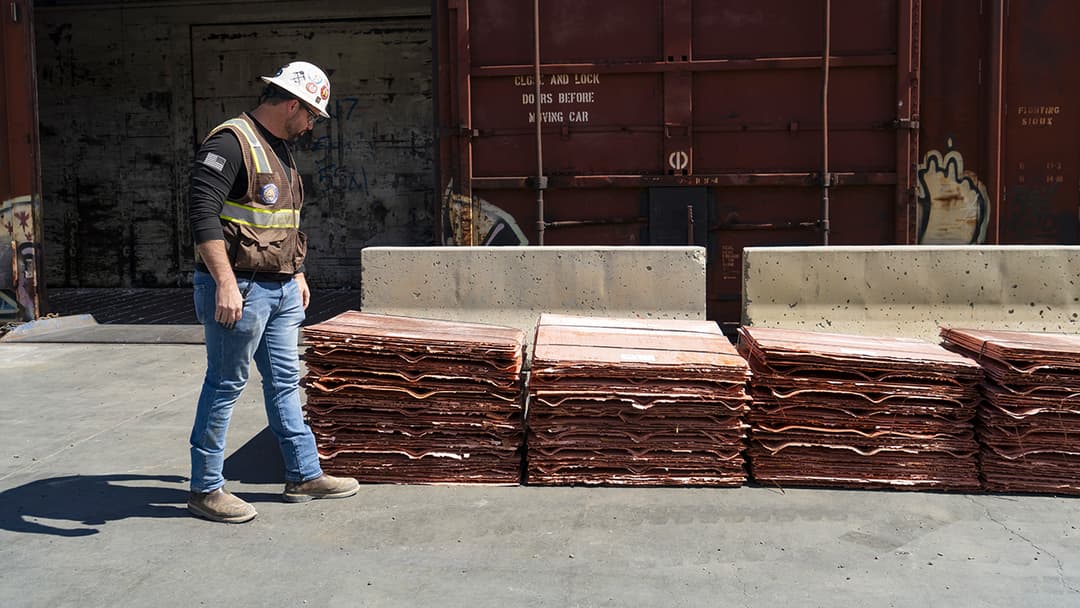
Amazon’s push to build massive artificial-intelligence data centers is now extending into Arizona, where a recently restarted copper mine is supplying industrial metal seen as increasingly critical to powering Big Tech’s AI infrastructure.
On Thursday, The Wall Street Journal reported that Amazon Web Services (AWS) signed a two-year agreement with mining giant Rio Tinto’s Nuton venture to secure copper supplies tied to its expanding AI data centers.
The Arizona mine outside Tucson — the Johnson Camp mine using Rio Tinto’s Nuton bioleaching technology — became one of the first new U.S. copper production sources in more than a decade when it resumed operations last year. The agreement covers approximately 14,000 metric tons of copper cathode over four years.
A.I. WON'T KILL YOUR JOB, BUT IT WILL CHANGE WHAT ‘REAL WORK’ MEANS, ROBINHOOD C.E.O. SAYS
"We work at the commodity level to find lower carbon solutions to drive our business growth," Amazon’s director of worldwide carbon Chris Roe told The Journal. "That means steel, and that means concrete, and it absolutely means copper with regard to our data centers."
The average data center uses roughly 5,000 to 15,000 tons of copper, according to the Copper Development Association, though the largest facilities can require tens of thousands more for wiring, transformers, circuit boards and power systems.
Even so, this supply represents only a small fraction of the copper needed for a single large data center, underscoring how substantial overall copper demand has become for AI infrastructure.
Amazon says it’s targeting lower-carbon materials across its supply chain. The copper will be supplied to manufacturers that make components for AWS data centers, while AWS is providing cloud computing and data analytics support to help Rio Tinto optimize Nuton copper production and recovery.
GET FOX BUSINESS ON THE GO BY CLICKING HERE
"It’s not just the fact that we’re processing ores that otherwise would not have been economic to process, but also that we do it at lower carbon and lower water intensity," chief executive of Rio’s copper business Katie Jackson told The Journal. "It’s great to see that there are customers who see that as part of the value proposition."
Last year, copper prices reached near record levels, with benchmark prices exceeding roughly $6 per pound amid broader global supply concerns as demand grows.