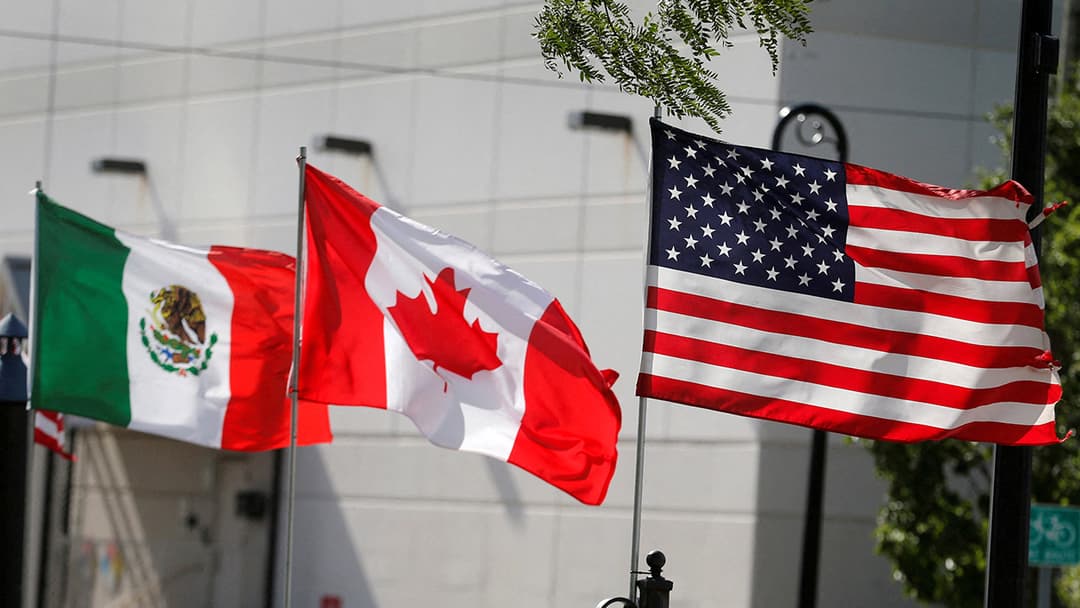
The Trump administration's announcement that it doesn't plan to renew the U.S.-Mexico-Canada Agreement (USMCA) and instead intends to pursue individual trade agreements with its two neighbors.
Wednesday marked the sixth year of the USMCA being in effect, a milestone which gave the administration the option of extending the agreement as is or opting against renewing it to address trade issues with Canada and Mexico. The USMCA will remain in place for 10 years while those negotiations occur.
The trade relationships with Canada and Mexico carry a great deal of significance for American businesses and consumers, as those countries are the two largest export markets for U.S.-made goods and are two of the three largest sources of imported goods.
While the USMCA helped modernize the U.S. trade relationships with its two neighbors, the official said that the trade agreement didn't adequately control trade deficits and added that it also fell short of expanding "market access opportunities in Canada and Mexico," citing issues like Canada's dairy restrictions and Mexico's threats against U.S. corn and corn products.
US DECIDES NOT TO RENEW USMCA TRADE PACT, WILL SEEK SEPARATE DEALS WITH CANADA, MEXICO
Rather than looking to extend the USMCA, which the president negotiated during his first term, the official signaled the U.S. could end up with bilateral trade deals instead.
"I could see a world where we have a protocol with Mexico or a protocol with Canada, within President Trump's term," the official said. "I think that's definitely possible if those protocols or if those agreements are really geared to and have the outcome of reducing our deficits with those countries."
The official added that the president "remains skeptical" of concluding some sort of agreement that makes changes to the USMCA and keeps the trilateral trade pact intact, though they emphasized that it's in all of the countries' interests to keep negotiating.
BESSENT LAYS OUT 5 PRINCIPLES GUIDING TRUMP ADMIN'S APPROACH TO ECONOMIC STATECRAFT
U.S. trade negotiators are expected to meet with their counterparts from Mexico on July 20 and the official said they expect to discuss issues including labor obligations, environment and water quality, and intellectual property in an effort to make more progress on those topics.
"We have already spoken in some detail with Mexico about strengthening the rules of origin of the agreement, about enhancing economic security alignment and resolving bilateral issues," a senior Trump administration official told reporters on a call announcing the move.
"You know, Mexico, although we have many challenges in our relationship, including on trade, they do understand the administration's tariff policies," the official explained. "In many ways, they've been constructive in this, they have made proposals about deficit reduction. And so we have been negotiating formally with them on a bilateral basis to address and resolve many bilateral issues."
CANADA LIFTS TARIFFS ON SOME US GOODS TO RESUME TRADE TALKS
The official added that "Canada is in a different position" after it imposed retaliatory tariffs on the U.S. following the president's move to levy Canadian goods.
"Along with the People's Republic of China, Canada was one of the only countries in the world to retaliate against the United States following the president's historic trade actions to eliminate the U.S. trade deficit and reshore manufacturing here," the official said. "They also have not addressed many of the non-tariff barriers and trade challenges they have had over the past years."
According to the official, the U.S. decision not to renew the agreement and move into a 10-year review phase doesn't mean negotiations have to take that long – though they added that President Trump could withdraw from the agreement before that review timeline concludes.
GET FOX BUSINESS ON THE GO BY CLICKING HERE
"The reality is, if Canada or Mexico completely get on board with what's needed, then that's a different situation," the official said. "At the same time, the president also reserves his right that's in the agreement and that's in law to withdraw from the agreement, even before 10 years."